Sunday, December 31, 2006

War is Swell

Today's Independent of London has an entertaining stroll through the Spring publisher's catalogues:

Stuff (Cape, April) recreates the adolescent years of Martin Rowson, who looks back with a near-photographic recall, as befits an artist, at the house he grew up in in the 1960s and 1970s.... Another spin on the theme of the Seventies childhood comes from Harry Pearson. In Achtung Schweinehund! A Boy's Own Story of Imaginary Combat (Little, Brown, Jan) he recollects long hours spent playing wargames, manoeuvring tiny soldiers around his bedroom floor and painting Airfix models.

A fascinating variant of the latter's genre is by Warhol-colleague William Anthony in his War is Swell: A Kid's Idiotic View of World War II. I first came across it at the inimitable Quimby's in Chicago, and this NY Press review by John Strasbaugh in 2000 summed it up best:

His anatomically incorrect figures–heads like lima beans, torsos like potatoes, crooked tits and wrong-way-bending limbs–are the perfectly inept illustrations for his boy’s own version of the war, all gleefully ignorant jingoism, racism and just plain doofism.

One of the first things you notice is that it’s not all that different from the view of war presented in Saving Private Ryan or most any other war movie. Indeed, there are panoramic battle scenes here every bit as epic in sweep as Spielberg’s invasion of Normandy. It makes you think maybe all war stories are told by boys, to boys (with a few notable exceptions like The Thin Red Line).

Not, I’d guess, that Anthony has so lofty an intent in mind. The book’s too funny, the drawings much too likably dork. (Warhol once said Anthony’s earlier illustrated rendition of Bible stories was the only version of the Bible he could read.) "The Japs, they started it by bombing Pearl Harbor," Anthony sagely relates. We learn that "Hitler’s girlfriend was Eva Braun. Hitler didn’t know it, but she would lock herself in her room and boogie to jazz records," and that "Kraut officers were all born with big dueling scars on their faces. Their favorite word was: SCHWEIN," and that "Whenever Hitler conquered a new country, he would do a dance."

In the end, though, justice prevails: "Hitler had Eva Braun go and poison herself in their bunker. Then Hitler poisoned and hung and shot himself. Then just to be sure, he burned the bodies."


The cover alone says more than I could possibly add:


Dickens on the Big Screen

I am referring, of course, to an actual wooden screen.

Macdonnell Rare Books has this curious item listed in their catalogue:

Dickens, Charles. THREE-PANEL ROOM SCREEN. [ca. 1890-1910]
This reading screen (or rather large fire-place screen, or rather small room divider) measures approximately five feet ten inches tall, each panel measuring twenty inches wide, connected by brass hinges. Each panel is covered on both sides with identical buff color wall paper printed in blue-green ink, over wooden panels, with muslin piping held by upholstery tacks, depicting the major characters and scenes from Dickens' novels: David Copperfield, Aunt Betsy & Mr. Dick; Dolly Varden; Mr. Pecksniff, Tom Pinch & Mark Tapley; Barnaby Rudge; The Blue Dragon; The Bull Inn, Holborn; Mr. McCawber, Dan'l Peggotty & Uriah Heap; Mr. Bumble; Mr. Pickwick & His Friends; The Old Curiosity Shop; Peggotty's House; and Sairey Gamp.... A wonderful artifact, of striking appearance, ideal for the library. Nobody can see what you're doing behind this screen, and you can do things you wouldn't dream of doing behind, say, a Thackeray screen...
USD $1650.00

Certainly it's more fun than anything you'd do behind an Ernest Hemingway Screen....

Saturday, December 23, 2006

Really Slow Food

One of my favorite freelance assignments of 2006 -- simply because it's so damn weird -- is in the current New Scientist on the edibility of food that is decades or even centuries old. Reading through ancient magazines and newspapers over the years I kept coming across "box of cereal under the floorboards" stories -- or "can of tinned clams in the rafters" articles -- usually about some geezer discovering food saved from their honeymoon, or workmen finding Victorian corn-flakes when they demolished a house.

Invariably these stories included the magic phrase: "they discovered it was still edible."

Every time I saw one of these, I'd photocopy it, and after four or five years of this I had me one wacky-ass article. Oh, and some great e-mails helped:

In 1997 Tony Rogers, a former employee at a Wisconsin-based chemical company, cleaned out his office desk to discover a Dolly Madison apple pie he'd purchased at a gas station 8 years earlier. Rogers' fruit pie autopsy, immortalized in photographs on his web site, has received some 245,000 visitors, thanks in no small part to his deliberately ludicrous correspondence with a hapless Interstate Bakeries customer care representative. But his exploits did not quite end there.

"Before I wrapped it all up," he says, "I did pick up a piece of the pie, and I actually ate some of it. My immediate reaction was that it was somewhat caramelized and somewhat chewy. But... it was the same taste.... I honestly think that if my pie was put back on a shelf in a gas station, someone would purchase it and they would consume it and not ask any questions."
Incidentally, here's Tony's 8-year old pie side-by-side with a new Dolly Madison pie:


Can you guess which is the safe one to eat? Well... both, apparently, since Tony told me he didn't get sick.

One of the strangest parts of my research came up when I repeatedly called the Prince of Wales's Own Regiment of Yorkshire Museum to confirm a rumor that they had a still-edible chocolate ration from the Boer War. Bear in mind that, thanks to the time difference, I was having to call at like 2 am my time -- and I kept getting volunteer docents picking up who must have thought that I was out of my mind.

But -- guess what -- their curator eventually discovered the rumor was true.

Better yet: as I was tracking that rumor down, I discovered an identical New Year's 1900 ration getting auctioned off on eBay under the title Queen Victoria Boer War Gift Tin With Contents.

Ever wondered what a 106 year-old Cadbury bar looks like? Behold!....


If my rivals in the 106-year old candy trade hadn't bid it up to $270, I'd have bought it myself. But.... would I have sampled it?

Well, funny you should ask: because when I looked just now, there's another 1900 chocolate ration in its final hours on eBay. So maybe at last I'll get to sample a bit of th....


Oh ... eh, maybe not.

Monday, December 18, 2006

Lunacy

Here's something you don't see too often on eBay: an 1859 reprint of The Moon Hoax.

I got my start as a writer with a McSweeney's article (excerpted here at NPR) on this 1835 newspaper hoax, which had New Yorkers convinced for a brief but glorious time that there was a race of man-bats living in ruby pyramids on the moon.


Sunday, December 17, 2006

Lost!

I generally avoid Best Of lists, but today's Observer of London has a good one: 50 Lost Movie Classics. The American movies will not be too "lost" on anyone from the US, but the foreign titles were certainly new to me.

Check this one out:

32 The Day The Earth Caught Fire
Val Guest, 1961

A brilliant London film, a great journalist movie and a classic example of period sci-fi cinema. Leo McKern is thrilling as the Daily Express writer (it was shot in the paper's old Fleet St HQ) who has discovered global warming - Val Guest's film seems more prescient every year. Also, there's an early cameo from Michael Caine as a policeman ushering crowds out of the city, a scene eerily reflected in Alfonso Cuaron's Children of Men this year.
I cannot possibly end this post without also noting the Observer's listing of the Le Petomane, "A forgotten masterpiece short starring Leonard Rossiter as Joseph Pujol in the true story of a man who had an elastic anus."

Wouldn't that describe an entire category of movies?

Arise, Kircher Society...

Everybody's favorite mysterious society of curiosities is holding its inaugural meeting in Manhattan on January 16th. (Tickets are $12 and well worth it.)

The proceedings will include a demonstration of the "universal musical language" of Solresol....


.... And yes, yours truly will indeed be, ahem, on hand for it.

Sunday, December 10, 2006

A Staple of My Diet

English as She is Spoke's descendants continue their reign of linguistic terror:

Redstone’s Christmas 2006 offering, Dr Clock’s Handbook, is an elegant hardback celebrating the absurd. Open it, and you might find extracts from a skew-whiff English phrasebook, compiled by literal translations of phrases in another language: examples include “Have you say that?”, “He does me some kicks”, and “I have mind to vomit”. Turn over, and you come across a picture of mashed potato with (possibly) an adornment of peas....

(The Times of London)
A book after my own heart. Read on --

....Next to that is David Shrigley’s London Tube map: an exact reproduction of the official one, except that in place of the grid is a jumble of spirals.

Another illustration is simply:

Saturday, December 9, 2006

In Praise of Olive

A couple years ago in the V_____ V____ -- their Dickensian personnel practices demand 19th century nomenclature -- I unveiled my minor discovery that Olive Logan was the first literary agent in America:


One of the hardest things in art, outside of creating it, is to be that very first person who looks at an unknown and his or her work and says: I like it. Any idiot can second the motion. But to look at an unknown and say, "You, yes you, you are worthy"—that is different. That means taking a risk, to say yes where probably dozens have already said no.... [Yet] In an industry that could be numerically defined by how much it rejects, the first agency in Manhattan was itself a flop. In the 1870s, famed stage actress and author Olive Logan began an agency with her author husband, William Wirt Sikes—but it failed because the manuscripts were terrible. Logan and Sikes were less gatekeepers than a representation service, and publishers had no great use for that. Logan, Manhattan's first modern literary agent, died in an asylum, destitute and demented—thus setting a time-honored pattern for all her other authors to follow.

To be fair, Logan and Sikes had no business model to follow. Nobody imagined publishers ceding their role of screening unsolicited manuscripts.... But now many publishers will not even look at this manila-enveloped tide of humanity: They happily leave that drudgery to agents. Publishers, to their great relief, no longer have to be the first to say: I like it.

It's probably worth pointing out that Logan also authored a number of books and wrote for Harper's, so actually she's an even rarer creature: the writer/agent. One of her books -- a memoir of stage life -- turned up on eBay a couple days ago and is already getting bids.


Say, here's a question: has anyone ever written a history of literary agents? Some scholar should. I'd certainly read it....

Monday, December 4, 2006

Life Before Monopoly

A fabulous find on eBay this week -- someone turned up Paul Pry: a New Game, a board game that dates to 1825. The seller couldn't find any previous record of it, and I can't either.


I'd have bid for it myself, if I could only convince my family that I really need a $500 board game.

One curious aspect of this game: "Paul Pry" was a popular stage character of the time. It seems that a board game based on a hit show is a very old idea indeed.

Long Weekend Stubble

After a weekend at the seaside -- Did you know elephant ears taste extra delicious when eaten out of season? -- we've returned to find this great Daniel Engber piece in Slate.

Squeak like a bat! Hit your friend in the face with a frying pan! Raise a chimp as your child!

What more could you want from an article?

Sunday, November 26, 2006

Sir, I Have a Complaint

The Paper Chase

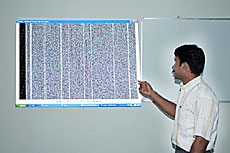
450 GB stored on one sheet of 8.5 x 11 paper?

Sounds like April 1st arrived early this year. Still, it's good geeky fun watching bloggers debate the idea....

(Intriguingly, the original Arab News article does give contact information for the fellow -- check out the end of the article.)

Saturday, November 25, 2006

Dead Plagiarists Society

I've a piece on googling plagiarism among 19th century writers on Slate this week.

One of the most enjoyable parts of writing it was seeing the extraordinary fecundity of language, simply by typing perfectly ordinary sentences in Google Book Search (or even just regular Google) and finding zero results -- or a mere googlewhack of one hit.

A sentence like this one, for example.

Sunday, November 19, 2006

Slated For Destruction

I'm reading at Powell's tomorrow night for the book Presidential Doodles.

Among the outtakes I'll have with me is a September 26 1918 editorial by the Clearfield Progress (PA) exhorting children and shopkeepers to doodle on slates instead of paper -- the better to save bleach and india ink to Macgyver them into, um, bombs or something. Go ahead and laugh, but Bulgaria surrendered to the Allies just days later.

Coincidence? I think not!

This reminds me of a surreal war-drive poster I used to pass every day when I lived in Iowa City; by happy coincidence it hung in the window of an antique store across from John's Grocery:


To quote one cooking explosives authority... BAM!

Saturday, November 18, 2006

Blackboard Jungle

"It turns out the sound waves associated with primate warning cries, particularly chimpanzee warning cries, are remarkably similar in appearance to the aversive, middle frequency sound waves produced by fingernails on a chalkboard..."

Saturday, November 11, 2006

Period Piece

The new issue of Fine Books & Collections notes Heidi Neilson's Typography of the Period, which magnifies and examines 26 different examples of the humble punctuation mark.


Sold for $25, it's being issued in an edition of 100 copies.

Oh You Beautiful Doll... (Not!)

A neat find while cruising some ABAA search results: the Heritage Book Shop has the full text of a bunch of previously unpublished letters by F Scott Fitzgerald, written from Princeton to his childhood friend Elizabeth Clarkson.

Here's one, dated September 26th 1913, from the Heritage's catalogue:

Dear Elizabeth:

Nunc Sum Studens. (Latin.) I am now a Princetonian. Its great. I’m crazy about it. Today we had the rushes. The Sophs mass in a body in front of the gym and the Freshmen try to rush their way in. You can imagine it. Four hundred Freshmen, among them yours truly, against 380 Sophs. Everything was ruined shirts, jerseys, shoes, socks, trou, hats ect. were strewn over the battle-field. I was completely done up. I was in the front row and a soph and I almost killed each other. I am a mass of bruises from head to foot. When we got in we elected a class President, Vice Pres. and sec. When we came out again the sophs. tried to bust our line. We beat H----- out of them. Then we paraded around the campus, yelling “whoop it up for seventeen,” which is a wonderful song. Then we cheered and sang. Zip!!! This is some place. I have a big piece of some soph’s shirt. Somebody has a big piece of my jersey. (Lord only knows who.) Tonight is the cannon rush so if you never hear from me again you’ll know I died a freshman. (gentle pathos.) The “horsing” (or hazing) is going on now. Its very foolish. Freshies have to carry their cap in their mouths and by the way our uniforms are some class (not)

[Here, Fitzgerald has drawn a humorous image of himself as a Freshman in uniform].

(Picture of me in my Freshman uniform)

Black cap --->Black jersey --->Cordoroy [sic] Trou --->Black socks --->Black shoes --->

The Sophs. make you tell a funny story and then won’t laugh but tell you to finish. Then they tell you to dig for the point. (N.B. You dig) This morning I gave a temperance lecture on the bidding of about fifty of them. Then I had to sing the death noticies out of the “N. Y. Times” to the tune of “Oh you beautiful doll.[”] I could fill up a lot of writing paper telling you about the place. It is wonderful. (Change of tone) (this is the part you musn’t read to your roomate) Well, Elizabeth, needless to say I am still your humble and devoted. Nanny Jackson and I are trying to fix up a sceme [sic] to bring you and Kitty down to a game. How the plan will work I dont know, I am crazy to see you and sure hope you enjoy “Miss Hartridge’s school for goils” my two weeks I promised is up but I am going to extend it until Christmas. If you hear any news from home write it to

Your freshman friend
Francis Scott Fitzgerald

I'm particularly fond of the notion of Fitzgerald singing out Times obits to "Oh You Beautiful Doll." Owning the evidence, though, will set you back 30 grand.

Also, take careful note: it appears Fitzgerald scooped Wayne and Garth on "Not!" by about eight decades. So whenever someone says that, they are quoting a great American novelist.

Sunday, November 5, 2006

Duck and Hardcover


An Oklahoma City candidate for state superintendent is examining the ability of textbooks at stopping bullets:

Crozier believes students could use the reading material while running away from an attacker. "The reason we are doing this experiment is because there was a kid in Fort Gibson who was shot in the back but the bullet did not penetrate his textbook." Using an assault rifle and various pistols, Crozier and his colleagues shot several textbooks in this home made video.
(Hat tip to Bookfinder)

Noted without irony in the story:

When asked about Crozier's idea the current state superintendent, Sandy Garrett, said she has implemented a statewide anonymous safety hotline for schools. In addition, every school is required to have a safe school committee and a state issued safe school handbook.

No yet word on the ballistics results for that handbook.

Saturday, November 4, 2006

Nul Points

The Telegraph reviews Tim Moore's latest book, Nul Points, a clever variation upon the old and honorable subject of Failure:

His latest wheeze is equally bizarre and, on the face of it, pointless: to track down and interview the 14 Eurovision acts who, since the voting system changed in 1975, received no points at all from any of the national juries. 'Nul points', he points out, has become such a widely accepted term for humiliating public failure that it even has an entry in the OED....

None the less, things look up when he goes to meet Jahn Teigen, the Norwegian Iggy Pop lookalike who was the first nulpointer back in 1978. Teigen, whose splay-legged leap at the end of his performance is seared into the memories of millions, is one of those boundlessly optimistic extroverts some of us would travel hundreds of miles to avoid, but Moore has fun with him, describing him as a 'chain-smoking serial gesticulator' and 'Norway's overlord of prog rock'... Finn Kalvik, Norway's second nonscorer in 1981, is found sunning himself on a Thai beach, and it slowly dawns on Moore that he's there primarily because it's not Norway: the humiliation rankles still.

Unfortunately, there's no US edition, and despite the fact that you really don't need to know anything about Eurovision to appreciate the basic idea of the book, I suspect that it won't get picked up over here. His previous book Do Not Pass Go -- also fascinating, funny, and without a US publisher -- was the subject of my first article for The Believer, and it's well worth picking up as a quite reasonably priced import copy on Amazon.

Sunday, October 29, 2006

Tiny Ninja Hamlet

Now, here's something I'd pay good money to go see....


...The Telegraph reports the Royal Shakespeare Company is staging Tiny Ninja Hamlet.

Saturday, October 28, 2006

The Molecatcher's Daughter

I'm on NPR Weekend Edition for this segment with Scott Simon about the most infamous murder case in 19th century Britain: the "Red Barn Murder" of Maria Marten by William Corder in 1827, and the media circus that followed his arrest. It also marked the beginning of modern crime writing: James Curtis's account The Mysterious Murder of Maria Marten reads like an In Cold Blood of 1828.

I write on Curtis and the case in "The Molecatcher's Daughter" in the November issue of The Believer and -- make yourself a pot of tea, it's 12,000 words -- they've got the entire article online.

There's also an extraordinary twist not noted in the NPR piece. The case produced a cache of unclaimed PO Box replies to a personals ad that Corder placed in the Times of London on November 25, 1827:

That the ad replies survived at all was due entirely to the notoriety of Corder's trial; otherwise they surely would have eventually been burned as unclaimed trash. But they are a unique record—a startlingly intimate peek into Regency-era life, with rootless young people leaving villages for industrialized cities and left to their own devices to form relationships. In this new urban world, where all one knew of anyone's past was what they told you, a predator could appear as a loving and gentle suitor—you could even marry a murderer and bear his child without realizing it.


As far as I know, no study has ever been made of these letters, and they haven't been reprinted anywhere in many decades. But Corder's personals ad and a selection from the nearly 100 letters he received in response can now be found here on The Believer's site.

The letters range from witty and arch to frankly desperate; what's particularly noticeable is the utter pragmatism and forthrightness of many of the responses. Hence:

[Sir,]

The advertisement of a private gentleman, aged twenty-four, in the Sunday Times newspaper, happened to meet the eye of a young lady, aged twenty-one, of the utmost respectability. The advertisement rather struck her; and, should the gentleman be really in earnest, he must advertise once again in the same paper, when he will hear further particulars. But the extreme modesty of the lady will not allow her to put her real name or address. The lady is at present in the country, but will shortly return to town.

N.B.—The lady is not very handsome.

Another response states flatly that "I have no fortune till the death of my mother." Which, well, might not have been the best thing to mention to someone like William Corder...

Sunday, October 22, 2006

Stephen Colbert Has A Time Machine

I just love the idea that this book could even exist:


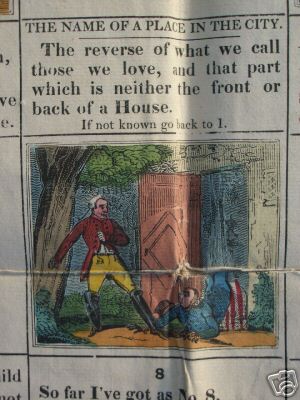
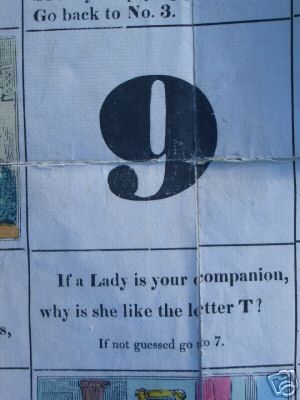
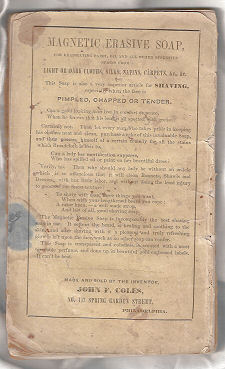
Better still, there's an ad on the back for "Magnetic Erasive Soap":


But... wait a second, turn back to that front page again and have a closer look....


My expert historical opinion: Stephen Colbert has escaped the bounds of time.

Step Into My Broadcast Booth, Baby

eBay find of the week:


Either That, Or Mark Leyner's Behind It

Is it just me, or is Aleksey Vayner the second coming of Hugh Gallagher?

Aleksey:


Hugh:

I am a dynamic figure, often seen scaling walls and crushing ice. I have been known to remodel train stations on my lunch breaks, making them more efficient in the area of heat retention. I translate ethnic slurs for Cuban refugees, I write award-winning operas, I manage time efficiently. Occasionally, I tread water for three days in a row.

I woo women with my sensuous and godlike trombone playing, I can pilot bicycles up severe inclines with unflagging speed, and I cook Thirty-Minute Brownies in twenty minutes. I am an expert in stucco, a veteran in love, and an outlaw in Peru...

Same person? You decide.

Saturday, October 14, 2006

The Smoke Ring

Caleb Crain takes up last week's post on Philip Morris and runs with the ball:

I thought I would see if I could find this particular document in the Legacy Tobacco Documents Library.... I'm guessing that Monbiot was referring to the "Proposed Plan for the Public Launching of the TASSC [The Advancement of Sound Science Coalition]," dated 30 September 1993, which on page 2 deprecates a launching through "top media markets" and prefers an approach that "Avoids cynical reporters from major media" in order to arrange for "less reviewing/challenging of TASSC messages."

The fee for a 20-city launch was $60,000, as you may read on page 8 of the memo, though Philip Morris was given the option of economizing: a 10-city launch would only cost $35,000. As the letterhead reveals, the PR firm that created TASSC for Philip Morris was APCO Associates. They seem to be in business still; according to their website, it is part of their "Culture and Values" to "Tell the truth." No doubt.

There are many more goodies on this over at his site. Monbiot's book is apparently the first to show Philip Morris's efforts preceding Exxon's, and it's a revelation that's had curiously little play in the US yet. But there are a couple curious previous stories that crop up. From a December 2005 NY Times book review of The Republican War on Science:
"Doubt is our product," declared a 1969 Brown & Williamson memo spelling out the strategy, "since it is the best means of competing with the 'body of fact' that exists in the mind of the general public." After the E.P.A. released a report on the dangers of secondhand smoke in 1992, the Tobacco Institute berated the agency for preferring "political correctness over sound science." Within a year Philip Morris helped to create a group called The Advancement of Sound Science Coalition (Tassc), which challenged the risks not only of secondhand smoke but also of pesticides, dioxin and other industrial chemicals. (The executive director of Tassc in the late 1990's was Steven Milloy, who now "debunks" global warming and other environmental threats in the Foxnews.com column "Junk Science.") Newt Gingrich and other Republicans soon started invoking "sound science" and "junk science" while criticizing government regulations.
The New Republic subsequently found a bounteously overflowing cornucopia of financial conflicts of interest for Milloy and his work as a "journalist." So you'd think Fox might stop using him.

But indeed they still do.

CBGB's Closing...

... And I'm still a schmuck.

Saturday, October 7, 2006

Dept. of Helpful Advice

I've an article in this week's New Scientist about the archetypal book release nightmare:

By the time he arrived in London for medical treatment in 1725, George Cheyne was in a terrible state. Headaches racked his brain, and gout blistered his legs in sores until they appeared "burnt almost like the Skin of a roasted Pig", as he put it. Above all, there was his weight, which at times rocketed to 32 stone (203 kilograms). He was left tormented with depression - and no wonder. That he was a physician himself was bad enough, but added to that was the crowning indignity: at this very moment, Dr Cheyne was being touted from the bookstalls as the diet guru of the day.

Cheyne nonetheless remained the favored physician of literati like Alexander Pope and Samuel Richardson, to whom he offered the helpful advice that the plot of Pamela needed more house fires and broken bones. (This, I think, would be 18th century literature's equivalent to demanding "More cowbell.")

Another would-be Pamela co-writer, by the way, was my old favorite George Psalmanazar. But I'm afraid Richardson wasn't too impressed with his contribution.

Smokescreen

Just when you thought Philip Morris couldn't get any more comically Bond-villain evil, it turns out that they have been covertly funding a global-warming denial campaign.

In his new book Heat: How to Stop the Planet Burning (a Penguin UK book with no US release -- what gives, Penguin?), Oxford prof George Monbiot dug up the documentation. From his interview on NPR's On The Media:

GEORGE MONBIOT: They realized that if passive smoking was the only thing they campaigned on, their fingerprints would be all over it. So they were advised not to campaign only on passive smoking but to link it with other issues which bore on regulatory matters, and the first of those issues was global warming.

BROOKE GLADSTONE: What's the evidence that you have to document this campaign?

GEORGE MONBIOT: The great thing about one of the big lawsuits against the tobacco companies is that one of the outcomes was to force the companies to put their archives on public record. And so you can go through the source material documenting exactly what their strategy is. And in this case, they say, we're going to set up this so-called grass roots coalition.... One of the campaigns, which was by far and away the most central to corporate-funded climate change denial, the Advancement for Sound Science Coalition and junkscience.com and the other things that it spawned, was actually started by Philip Morris rather than by Exxon. And Exxon only came in later.

Monbiot also ripped micro-power advocates a new one in a recent New Scientist piece by revealing how their shaky home generation statistics often hide a lousy return on investment, and more generally noting that you get vastly greater efficiencies of scale by pushing for large alt-power generators (offshore, say) and then bringing it in over transmission lines.

It's a point reminiscent of one raised by Elizabeth Royte's wonderful Garbage Land -- a point late in the book which few reviewers noted, by the way. After tracking the trail of her trash throughout the Northeast, she's appalled to discover that industrial and ag sources produces exponentially more waste than households do. In other words, by the time consumer goods reach you, your little efforts at virtue are pretty pathetic. It makes far more sense to (a) reduce demand, and (b) regulate the manufacturing process. But we're so busy feeling good about sorting plastic from aluminum that industry can do pretty much what it damn well pleases.

Sunday, October 1, 2006

Ever Feel Outnumbered?

Graffiti noticed this afternoon by Dan Savage:


Beware The Fake Dentist

Over in The Scotsman, Stuart Kelly reviews Magnus Magnusson's Fakes, Forgers, and Phoneys, which notes such delights as "The Odontist (a poor 19th-century dentist who became a literary sensation despite the fact all his poems were jokes made up by Sir Walter Scott's son-in-law)." But it also brings up an interesting subset of forgery: the real that appears to be fake.

One of the loveliest parts of Magnusson's book is the account of Ellen and William Craft. Their autobiography - Running A Thousand Miles For Freedom - related how they escaped from the Southern States disguised as a white master and his servant. Part of the problem with reading about fakers is the suspicious cast of mind it gives the reader. Was this a faked piece of abolitionist propaganda? A cynical tug on the heart strings, albeit for a worthy cause? No. Ellen did pass herself off as a white man, and escape from slavery with her husband.

Judge for yourself -- U Virginia has the entire text online.

Mean, But Funny

"She was wearing a large tuft of feathers on one side, as if a bird had flown into her head."

Saturday, September 30, 2006

What a Life!

Over at the Telegraph, John Gibbens drops in on my old haunt, Booth's in Hay on Wye:

Could one succumb to an overdose of second-hand books, like a king to a surfeit of lampreys? I hadn't thought so until I visited Booth's in Hay-on-Wye, the self-proclaimed World's Biggest Second-hand Bookshop. The wilderness of shelves receding into twilight, the sheer mass of volumes, staggered my brain; the air of ageing paper caught in my throat, and I fled, back into the streets of this little village that is a bibliopolar metropolis.

Yup. That sounds about right.

What he does find in Hay, though, is a book (The Second Post) by the very prolific E.V. Lucas, whose work I only just discovered earlier this year in much the same way -- in my case, by picking up an old copy of Lucas on Charing Cross.

Though out of print now, Lucas and George Morrow laid the groundwork for Donald Barthelme, Terry Gilliam, and innumerable others with their 1911 "autobiography" What a Life!, which cut and paste department store catalogue illustrations around an absurd narrative. The book is now online:

The eccentric Sir William Goosepelt was a friend of mine. Among his other odd ways he often indulged in the luxury of a treacle bath.


Sir William's ears were so large that he required a chin-strap to keep his hat on. From this circumstance he earned an unenviable reputation for impoliteness towards ladies.

Borat's Glorious Ancestor

Loyal readers will remember Alex MacBride: he was the UCLA linguistics grad student who, after seeing our hardcover edition of English as She is Spoke, contacted me with the first really convincing theory of how the disaster that is English came about. In a nutshell: Pedro Carolino probably hijacked Da Fonseca's perfectly decent Portuguese to French phrasebook and ran it ineptly through a French/English dictionary.

I just heard from Alex this week -- he's now a linguist at Google -- and he sends great news. Namely, Google's book digitizing project now has the original 1855 edition online.

Makes happy is! Make for you to run fasts to seeing excelling book!

Sunday, September 24, 2006

Japanese As She Is Spoke

Looks like The Scotsman is the first out the gate -- or the only one turning up on a Google News search, at least -- to review the English edition of Train Man, a book that has been a phenomenon in Japan.

It has its roots in 2004, when an anonymous internet user posted a message on a popular Japanese board to describe a fracas on a subway. He had been sitting next to a beautiful woman on the train when a drunk entered the car and began hassling the passengers. When he began to badger the woman, the internet poster told the drunk off and became involved in a brief struggle before the police were called. In the excited chatter on the board, the poster soon received the nickname "Densha Otoko" (Train Man).

Later, Train Man posted to tell his fellow netizens that he was astonished to receive a gift from the young woman to thank him for his bravery; two cups and saucers made by Hermès of Paris. Egged on by his fellow geeks he arranges to meet "Hermès" and the uncertain progress of their romance is aired in front of thousands of eager computer users.
"So far," they note, "Train Man has been translated into five manga comics, a film, a theatre play, a guidebook and a two-hour television special dramatising the story."

Sounds interesting enough. But, the review notes, it might be sunk by what sounds like an overly literal translation: "Idiomatic Japanese phrases are translated into a disjointed quasi-English: "This blow opened up the floodgates connected to the Geek's tearducts which had long been arid as the land on Mars."

Uh-oh.

Colbert on the MacArthur Awards

Quite possibly the funniest thing I have seen all week, and maybe all month:

Saturday, September 23, 2006

Big Doodle Bang

This week Cabinet magazine and Basic Books released Presidential Doodles, to plenty of gratifying press coverage. (Ahh, the writer's oxygen!) I wrote the book's foreword, Doodlers-In-Chief, and you can read the full text here. It was a fun project, and not least because I quickly discovered that... well, nobody had really written a history of doodling before. I had no precedent to draw upon.

So: I made my own history of doodling.

Not the least of my challenges was explaining the strange lopsidedness of the book. Namely, Cabinet's researchers were finding way more doodles from after 1850 than from before. After much head-scratching, I laid out my Grand Unified Theory of the Big Doodle Bang:

The labor of quill writing meant that an eighteenth-century meeting required a secretary to take notes: others were not expected to trouble themselves with writing, and the secretary was certainly not allowed to doodle... In fact, three things needed to happen before doodling could become, if not the Sport of Kings, at least the Fidget of Presidents. The first was the invention of the steel-nibbed pen. Like any terribly useful invention, nobody can quite agree on its origins. One of the earliest accounts places a steel pen in the hand of a certain Peregrine Williamson, a Baltimore jeweler in the first few years of the 1800s. Peregrine was terrible at cutting quills; in desperation, he contrived a sort of steel quill that would never need sharpening. He didn’t keep his jerry-rigged contraption to himself for long, though: soon, he was making $600 a month from his invention. By 1823, the Englishman James Perry was mass-producing them, and a new generation of children learned to write with the newfangled metal quill. “The Metallic pen is in the ascendant, and the glory of goosedom has departed forever,” one textbook stated flatly.

But then there’s the matter of paper. Paper was manufactured from old rags, and by the age of the steel pen, demand was outstripping the national supply of used underwear and grubby bonnets: paper was expensive, and not the sort of thing you’d waste on aimless scribbles. Everything from hay to hemp was tried out as a substitute material, with mixed results at best. It took the German inventor Friedrich Keller, in 1843, to develop the first recognizably modern process for mass-producing paper out of ground wood pulp. The resulting product was easily shipped via burgeoning rail systems. Soon, paper was abundant; it was sold by the pad, the memo book, and the sheaf.

Writing itself became looser and more doodle-like. Itinerant penmanship instructors, often juggling other fashionable sidelines in daguerreotyping and cutting silhouettes, distinguished themselves in the mid-1800s with manuals featuring ever-more baroque swirls and flourishes, not to mention fanciful drawings of angels, birds, and grinning fish; indeed, the title page of at least one textbook is so covered with this calligraphic frippery that the words themselves are obliterated. But by the time of Abraham Lincoln, a generation of children had grown up with increasingly affordable pencils and steel pens. These youngsters practiced flourishes, repeated words over and over, and sketched out fanciful beasts in cheap notebooks and on the endpapers of Latin grammars—and, just as their schoolmasters had claimed, a few would grow up to be president.


One of these was Harry Truman, and yet when Cabinet contacted his Presidential Library, they claimed Harry didn't doodle. That's funny, I told my editor Sina, because right now I'm looking at a Truman doodle in an old New York Times article.

Sleep contentedly, America: the historical record now stands corrected.

Sunday, September 17, 2006

That's Life

The Japanese version of Life, duly noted over at the fabulous Engrish.com :


.... Black and Bitter?

Saturday, September 16, 2006

This Week in Weird-Ass Books

Goofy binding of the week:


Baxter's Second Innings (1892). A children's book about cricket that, naturally, resembles a... um, a peppermint stick? Sure, okay. You lick that binding. The diagonally pasted title only deepens the mystery. My guess is that they realized the labels were wider than the book after they printed them all up, and they didn't want to... well, you know, pay for another print job. Hence: diagonal titling!

Font of the week:


The cover of Down the Great River (1888), by Capt. Willard Glazer. Isn't that just awesome? Try finding that one in Quark, smartypants.

And now, a giant octopus:


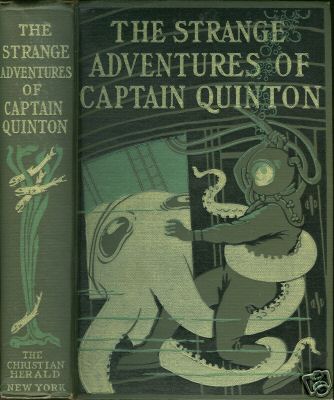
Yep, it's The Strange Adventures of Captain Quinton: Being a Truthful Record of the Experiences and Escapes of Robert Quinton During His Life Among the Cannibals of the South Seas, As Set Down By Himself. I run into this book occasionally, and let me just say now that it is my favorite cover illustration and title ever.

No reason, really: it just always makes me smile.

Caleb Crain's blog...

...has returned from a summer's rest with a neat little discovery: the New Yorker in haiku.

Sunday, September 10, 2006

The Billion Lira Note

While talking over dinner at the festival, conversation naturally turned to... television. (Hey, I'm only human.) Apparently about 15 years ago there was an Italian game show that would give a gigantic wad of lira to the contestant -- equivalent, say, to 100,000 Euro. The one rule was that you had to spend all the money in an hour.

Anyone who has encountered Italian shop hours, or tried to get any order filled quickly there, will quickly realize why this is the most cruelly funny idea ever devised for a game show. Contestants would typically try a car dealership first, resulting in exchanges like this:

"I want to buy a car!"
"Excellent! Come by tomorrow and we'll do the paperwork."
"No, I need it now. Now!"
"Ehh..."
"I have the money in my hand! For your most expensive car! This hour! The. Money. Is. In. My. Hand!"
"Today's not so good."

It being Italy, a wine merchant was the next logical stop:

"I need 20,000 bottles! I have your money right here!"
"Ehh..."

The show's producers rarely lost their money.

This is surely the only game show to be the living embodiment of a Mark Twain story.

Saturday, September 9, 2006

Festivaletteratura

I'm just back from the Festivaletteratura, Italy's largest literary festival and what may soon become a required stop for anyone who wants to bookend their summers between the Hay festival and a trip to Italy. Like Hay, it's held in an impossibly gorgeous old town (Mantova). But because Italian bookstores are dense with translated work -- the children's author Bianca Pitzorno estimated to me that roughly 70% of their bestsellers are foreign translations -- it means that there's a very noticeable international presence among the authors there. Aside from yours truly, David Sedaris, Julia Kristeva, and Jasper Fforde were all in town for it too.

So, really: you should go next year. It's pretty awesome.

The first thing I learned in Italy: apparently most of my readers are there, and not America. Who knew? This is the first time that I have ever sold out an event, or been ambushed by photographers at the door.

The second thing I learned: even if you're not particularly fond of coffee, it is possible to become addicted to really well-made cappuccinos.

The third thing I learned: that I cannot recommend five books to anybody.

Bizarrely, in the course of 10 interviews in a row on Wednesday alone -- a guaranteed way to lose your grip on reality, incidentally -- I was asked 5 times in succession: "Name 5 books that everyone should own." The first to throw this spanner into my gears was a TV crew from RAI 1, one of the national channels. My response: to stand stunned for a moment and then say, "Turn off the camera. I need a minute."

Eventually, I gave them this response: "Everybody should have five books that they haven't seen in anybody else's house."

I thought that was that, until the next interviewer asked the same question. And the next. And the next. Finally, sitting between translator Nicola Nobili and journalist Stefano Salis at a public interview in the Giardino di casa Martinia, I was cornered by the (friendly) crowd:


"What five books should every home have?"


At first, I responded: "I recommend books to individuals. I can't imagine recommending one book to everybody.... if someone tried that on me, I'd run in the other direction."

"Thank you for explaining this," one member of the audience said while a translator whispered simultaneously in my ear. "Now, tell us: what are the five books?"

Uh-oh.

"Ok," I sighed. "I'll give you one. Three Men in a Boat, by Jerome K Jerome. It's not edifying, and it's not morally or philosophically elevating. But it has the warmth of human presence -- and that is the highest praise I give to a book."

"Thank you," came a response. "You have four to go."

So I gave them one at a time, though they had to pry them out of me in successive questions: Dodie Smith's I Capture the Castle, Lee Meriwether's A Tramp Trip: How to See Europe on 50 Cents a Day, Religio Medici by Thomas Browne, and Burton's Anatomy of Melancholy. They were not, I explained, five books for every home, nor were they five books for for all time. They were just five books on my mind that week.

I'm not sure that I can explain my resistance to issuing a personal canon, but I'm even more bewildered by the desire for one. To, the personal search for books is at least half the point: and it is utterly dependent on whatever odd cicrumstances, moods, and places happen to converge on any given day. Moreover, my stock of books constantly shifts every time I move house. I reevaluate what each book means to me, and whether I even want to keep it around.

But in retrospect, I suppose the question was really a simpler one, and had little to do with canons at all. At least, I hope so. At its root, it is simply a variation on "Tell us about yourself."

Strangely, for a memoirist, I really have no idea how to answer that question either.

Sunday, September 3, 2006

In Praise of Fake Vomit

This week over at The Stranger, I delve into Kirk Deramarais's Life of the Party, a beautiful new visual history of the S.S. Adams Company.

Haven't heard of S.S. Adams? Well, you've certainly been squirted, buzzed, and otherwise annoyed by them:

In 1904, Soren Sorenson Adams was a Danish immigrant toiling in a dye factory bedeviled by a chemical byproduct that induced violent sneezing. Voila!—sneezing powder was born, and so was the Cachoo Sneeze Powder Company. By 1906 it was the S.S. Adams Co., and a new American industry in squirt rings and exploding cigars was born. Nickel and dime wackiness flew fast and furious out of their New Jersey warehouse: 1908 heralded the spring-loaded Snake in the Jam, and the next year brought us the immortal Dribble Glass. It's comforting to imagine Henry James's grandchildren afflicting him with this crap.

Ah, I can't help it: I just love the idea of Henry James with a dribble glass.

One additional tidbit, which got sacrificed to the Word Count God and didn't make into the Stranger:

The other Adamic father of gag art was the Johnson Smith Company of Mt Clemens, Michigan; innumerable children pined for their iconic X-Ray Specs. Their 1929 catalogue was reprinted in 1970 as a facsimile edition with an introduction by Jean Shepard—a perfect pairing—and it's well worth digging up from used bookstores. Put Life Of the Party over one eye and a battered old Johnson Smith catalogue over the other, and you'll have your very own pair of x-ray specs into American childhood.

Cheap copies of the Johnson catalogue --both in it's original and Shepard editions -- turn up all the time on eBay, and it's an ideal coffee-table purchase. Kirk himself has a great page on 1970s Johnson Smith comic-book ads...

It's Been Several Days...

...and I still don't know what to say about this.

It's not actually a mystifying decision -- it's been all too clear that the Village Voice's new owners have been taking a belligerent-drunk-with-a-chainsaw approach to the staff changes. But it should be a mystifying decision. Ed Park has been, bar none, the best and most encouraging editor I've ever worked with.

I mean, where else could I cover inept stuttering novels and Victorian monkey sex-ed?

Of my only two remaining must-read alt-weekly book sections (The Stranger and The Onion A.V. Club), neither originate from NYC. Hmm.

Sunday, August 27, 2006

The Folio Hunter

I've an article in the new issue of Smithsonian about Anthony James West, whose two-decade quest has had him tracking down and examining every Shakespeare First Folio in the world:

His work for the Oxford University Press series The Shakespeare First Folio: The History of the Book may qualify him as the most indefatigable pursuer of a single edition in literary history.... Newly discovered Folios still turn up. In 2004, Anne Humphries, a homemaker near Manchester, was named the sole survivor of a relative she'd never heard of; among the estate was a Folio that executors listed as "presumed to be a facsimile." Not at all. West discovered another Folio in the public library of the Yorkshire mining town of Skipton; the book had been mislabeled and forgotten.

As long as Folios are misfiled in libraries and hiding with long-lost relatives, the count of 230 copies will inch upward. At least a dozen known copies remain untraced. "I have about 130 leads," West says, adding that some are "quite hot."

Cricket Obits

Carefully hidden away in the one place I would normally never think to look -- namely, the sports section -- this week the Independent of London excerpted a couple dozen entries from a "a new bizarre collection of obituaries published in the Widsen Cricketers Almanack since 1892."

A few samples...

DOYLE, SIR ARTHUR CONAN, MD, the well-known author, born at Edinburgh on 22 May 1859, died at Crowborough, Sussex, on 7 July 1930, aged 71. Although never a famous cricketer, he could hit hard and bowl slows with a puzzling flight. (It is said that Shacklock, the former Nottinghamshire player, inspired him with the Christian name of his famous character, Sherlock Holmes, and that of the latter's brother, Mycroft, was suggested by the Derbyshire cricketers.)

AINLEY, ANTHONY, who died on 3 May 2004, aged 71, was an actor and a keen club cricketer for The Stage and London Theatres CC. "He was an eccentric and very effective opening bat who appeared in full body padding, sunblock, helmet and swimming goggles," according to his fellow-actor Christopher Douglas, "and he had a penchant for charging down the track and smashing the ball back over the bowler's head." Ainley followed his father Henry on to the stage, but found his greatest success on television as The Master, the arch-enemy of Doctor Who, in the 1980s. At one club game at the time, Ainley's fame preceded him, and the Sutton and Cheam Herald ran a headline above its match report proclaiming that "Inter-Galactic Terror" had been visited upon Surrey. A complex character, he usually took his cricket teas alone in his car - possibly because, according to one report, he "despised cheeses of all kinds".

CRISP, ROBERT JAMES, DSO, MC, who died in Essex on 3 March 1994, aged 82, was one of the most extraordinary men ever to play Test cricket.... His defining moment came in the Second World War when he was an outstanding but turbulent tank commander, fighting his own personal war against better-armoured Germans in Greece and North Africa. He had six tanks blasted from under him in a month but carried on fighting.... before being invalided out in Normandy. The king asked if his bowling would be affected. "No, sire," he is alleged to have replied. "I was hit in the head."

FOWLES, JOHN ROBERT, who died on 5 November 2005, aged 79, was a novelist whose work included The French Lieutenant's Woman. Cricket remained a lifelong interest, from the time Fowles learnt the game from the Essex captain, Denys Wilcox, at Alleyn Court prep school in Westcliff-on-Sea. While watching England nervily bat to victory over the West Indies at Lord's in 2000, he was joined in his living-room in Lyme Regis by a stranger asking the score. When Fowles told him, the visitor sat down and watched with him until Dominic Cork had hit the winning runs. Only when he asked how much Fowles charged for bed and breakfast, did both men realise that the stranger had walked uninvited into the wrong house.

Saturday, August 26, 2006

London Monkey Nuts

I came across The Dangerous Book for Boys in London last month -- it jumped out because there was simply nothing else quite like it in the store:


So I was delighted to see TLS, of all people, lauding it this week -- "Cloth-bound, gold embossed, reassuringly heavy, it mercilessly tugs at the heartstrings of anyone old enough to have ever read a Boy’s Own annual... They seem to be entirely serious in their quest, and with only traces of irony they have compiled a book that is packed with articles on such atavistic topics as conker fights and the manufacture of water bombs, invisible ink and the rules of cricket..."

There's no sign of a US release, and I suppose there might never be -- you'd need to be an expat or a serious Anglophile to revel in this book. But it's just the thing to go along with a viewing of Ripping Yarns, or to delight in evocative trivia:

In a book that revels in the peculiarities of the English character, my favourite section was on the phonetic alphabet. Before the standard version was established (Alpha, Bravo, Charlie, Delta, etc) the RAF had its own version, which was thought to be more suitable for the British accent. This seems to encapsulate the aims of The Dangerous Book for Boys itself, preserving in twenty-six words a whole chapter of English social history – Ace, Beer, Charlie, Don, Edward, Freddie, George, Harry, Ink, Johnnie, King, London, Monkey, Nuts, Orange, Pip, Queen, Robert, Sugar, Toc, Uncle, Vic, William, X-ray, Yorker, Zebra.

Shandy Girl

I've been semi-obsessed with Japanese bands for the last few months -- much more on that at a later date. Until then, enjoy the album art that I stumbled across yesterday on a recently released EP....


The track listing includes a song called "Shandy Girl," which I like to imagine has something to do with Laurence Sterne. But maybe it's just about beer and lemonade...

Sunday, August 20, 2006

Remember That Guy Who Saved His Comic Books?

Well, he's laughing at you now.

(There's great continuing coverage of Davis Crippen's $2.8 million comix El Dorado over at the Dallas Observer...)

Can You Hear Me Now?

Yes, it's a musical instrument composed of 126 vintage Bakelite telephones:


Which reminds me: NPR had a great piece a couple weeks ago on a weirdly prophetic yet inept video jukebox from the 1960s called the Scopitone. You can see scores of them in all their warbly glory -- like this French scopitone video for "My Year Is A Day" by Dearly Beloved (aka Les Irresistables) -- over at Youtube...


Saturday, August 19, 2006

If Rob Zombie Had Been a Bookbinder...

Damn you, Fine Books, stop reading my mind!

Scott files a report on the one thing creepier than snakebound books -- anthropodermic binding:

It turns out that 2006 has been a big year for human skin bindings. Christie's sold another one on June 30, referring to the material as "peau humaine." Everything sounds better in French, doesn't it. The book was Souvenirs d'une Cocodette, ecrits par ellememe. Leipzig: Landmann, 1878. The binding was executed in 1883 for Alexandre Coccoz by Francisque Cuzin for Georges Mercier fils, according to an enclosed note. Sold for $6,000. I couldn't find any other auction records for human skin bindings in the last 30 years.

As it happens, I have an article coming up in the not-too-distant future that touches upon a particularly nightmarish case of anthrodermic binding, as well as the collection at Ursus Rare Books that Scott goes on to mention. Scott finds an anthrodermic copy of Holbein's Dance of Death that sold for $1,320 -- and Holbein does seem to be a favorite, as I have here a 1898 Times of London article describing the Sotheby's sale for £10 of one "H. Holbein, Alphabet of Death, 1856, printed on China paper and bound in human skin, with a weird design combining a skull and an owl."

Say, here's a question: What new book of 2006 is most likely to have someone bind it in human skin? ...

Sunday, August 13, 2006

Here in My Car

Today's Times of London covers an Asperger memoir, Daniel Tammet's Born on a Blue Day:

As an isolated and obsessive little boy, he spent his time covering the inside of the garden shed with ancient Phoenician lettering, and was fascinated by the fact that all three of his childhood home addresses were prime numbers: 5, 43 and 181. He sees any prime number as a beautiful round pebble. At the same time he has virtually no sense of direction, gets lost easily and struggles to remember left from right. He becomes anxious if his routines are upset, the rigid order of his day beginning with exactly 45g of porridge for breakfast.
He's in some good company, of course: over in today's San Francisco Chronicle, Gary Numan talks about his Asperger's diagnosis.

Saturday, August 12, 2006

The Madwoman in the Library

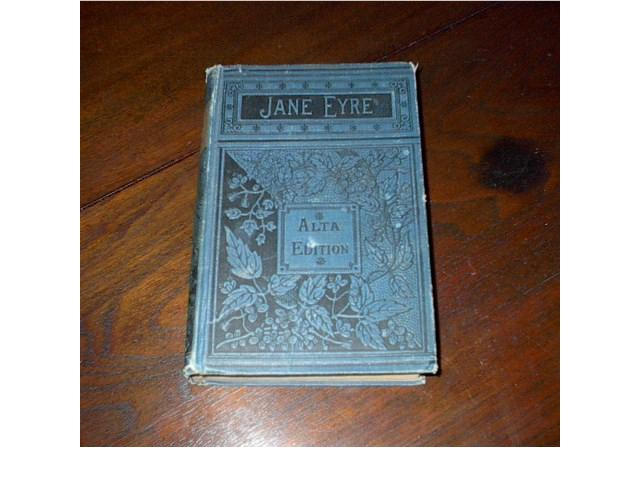
Did you hate Jane Eyre?

Not as much as this person did:


From an eBay item the seller rather hopefully labeled Rare 2nd Edition Jane Eyre 1847 -- Has Bullet Hole!


It had no bids....

The Plagiarism Remainder Table

Hey, remember when people were trying to get $200 for a copy of Opal Mehta?

Well, not anymore.

Too Stupid to Be A Scientist

"Dangerous Chemicals + Sleep Deprivation = Science!"


(Spotted by Inside Higher Ed.)

Sunday, August 6, 2006

A Modern Grub Street

LA Weekly on the early years of manga, thanks to godfather Yoshihiro Tatsumi's appearance at Comicon:

Comic-book artists in Japan, Tatsumi is saying, are workers for hire. He would often be asked to draw 50 pages a night.... Tatsumi talks in the lecture hall about drawing and Japan in the 1940s. “I feel as if I had no choice in the matter,” he says. “The level of poverty in Japan was quite severe. If I was to take up music, I would have to purchase instruments. To me, it seemed the most reasonable thing to create comics, because all you needed was a pen and paper.”

His next work is an autobiography that's been eleven years in the making.... presumably not at the rate of 50 pages a night. (Ah, but wouldn't it just be insane if it was?...)

Not Outside to Garden, Presumably

It always delights me when newspaper book sections break from the sales-cycle format and cover books that have been out for years. This week at The Stranger Charles Mudede pondered Wilkie Collins's The Moonstone, in the Guardian Umberto Eco reviewed, er, Banvard's Folly (the same review's turned up again!), while the Telegraph carried a fascinating piece on Colin Wilson's once-fashionable book The Outsider:

In its day The Outsider was that rare thing - a superselling work of philosophy. In its first few months of publication it raced through 16 editions, selling 40,000 hardback copies. Eat your heart out, de Botton. It's just 50 years, to the month, that Outsider fever swept literary London.... The London literary world of 1956 was, as Wilson put it, 'mothbally' and due for a shaking up. Wilson, with his polo-neck sweater, duffle coat, wild hair and geeky horn-rims - 'the sleeping bag philosopher of Hampstead Heath' (Osborne's snide description) - was heaven-sent for the part of shaker-up in chief.

The opening sentence of The Outsider was, that summer, as famous as that of the Communist Manifesto: 'At first sight, the Outsider is a social problem. He is the hole-in-corner man.' On publication the book received rave reviews. The Observer proclaimed it 'better than Sartre'. The Sunday Times thought it 'remarkable'. The Listener declared it the 'most remarkable' book the reviewer had ever come across.

I'd barely heard of Wilson before, but googling him did turn up this amusing exchange:

P.N. Surveying your work, it becomes apparent that you have written a great number of introductions - thrown seals of approval around with generous abandon. Do you think a serious writer should commit himself to so many projects. I once read a book on gardening with an introduction by you describing your detestation of the subject.

C.W: You may well be right about that, I'm afraid. In the case of the gardening book, someone wrote to ask me, "Will you write an introduction?" I wrote back, "Why me? I hate gardening." And he said, "That's allright - tell us about how you hate it." So I did. I should have refused of course.

Saturday, August 5, 2006

Boo!

Over in today's San Francisco Chronicle, I review Deborah Blum's Ghost Hunters: William James and the Search for Scientific Proof of Life After Death.

Among those who turn up in the book is Mark Twain, who beneath his crusty surface harbored a hesitant belief in ghosts. He certainly was a haunted man: Caleb Crain gave me a heads-up this week that Twain's annotated copy of Moncure Conway's Autobiography is up for sale. (Alas, it's an eye-watering $35,000). In the margins of Conway's anecdotes about Twain, the bookseller notes this unnerving reflection on mortality: On another page, after noting the names of his childhood friends in Hannibal, Clemens writes, "They are all gone; why were they created?"

Sunday, July 30, 2006

The Amazing Disintegrating Book

Scott Brown of Fine Books & Collections has been keeping a splendid antiquarian Fine Books Blog; one of my favorite posts is a classic good news/bad news combination.

Good news!... He's discovered an unrecorded first edition by R.K. Narayan.

Bad news!... It's covered in black mold....


As Scott describes it:


The pages weren't "cut," they were disintegrating from mildew. The paper literally fell apart in my hands as I turned the pages. Black mold crept in from the edges and some pages were almost consumed by the stuff. I quickly photographed it (My wife downloaded the pictures from the camera and put them in a folder called "Scott's Funky Old Book"), put it in a Zip-Lock bag, and stuck it in the tool closet, as far from the rest of my books as possible.
Someone should sponsor a contest for the most shot-to-hell-and-back copy of an old book. I've got a few that would be fine contenders.

Saturday, July 29, 2006

Shut Up and Read

Hey, remember how your medieval lit prof told you that people never used to read silently? Umm, never mind about that, today's Guardian reports:

It is a myth that the ancients only or normally read out loud - a myth we appear to want to believe, since the evidence against it is strong.... I consulted Alberto Manguel's A History of Reading (Flamingo), which was published in the same year as Gavrilov's and Burnyeat's articles. Manguel believes that the passage in Augustine is "the first definite instance [of silent reading] recorded in western literature". He is well aware of the evidence to the contrary, but he finds it unconvincing. Thus Manguel: "According to Plutarch, Alexander the Great read letter from his mother in silence in the fourth century BC, to the bewilderment of his soldiers."... But these bewildered soldiers are Manguel's importation. They have been brought into the story in order to make it seem exceptional. Manguel shamelessly fudges the argument.

Interesting....

Pot, meet Kettle...

...Kettle, meet Pot.

A Curious Example of Hidden Writing

A very peculiar item turned up on eBay this week: the owner of what initially looked like merely another 19th century scrapbook of newspaper clippings peeled away some newsprint and discovered a hidden journal underneath:


The seller goes on to describe it:

I decided to see if I could clear the first few pages to see if the owner's name, or scriber of the journal was present. Selecting the pages that had lo[o]se clippings I removed enough using steam and in some cases a mild warm vinegar solution with a thin artist pallet knife. My first discovery was that the beginning of the journal was kept by "The Wife of Husband Ellis Clerk." At first I thought that is was "Ellis Clark" and an internet search of the 1880 census data did find an Ellis Clark with an 1807 birth date. Only thing was it listed him as a farmer and residing in Pennsylvania at that time, which led me to believe it was not our guy as the newspaper clippings are mainly from 1880-81 New England publications. After viewing multiple entries it struck me that it may be "Clerk", and not Clark.

Next I cleared the inside front cover which was also covered with clippings, these came off rather easily but did not help. I then went to the first page which right in the top in large type-set print was "C DWIGHT ELLIS", as they say, never ignore the obvious. This time the 1880 census turned up a Dwight Ellis, born 1807 in Massachusetts, now age 78 at the 1880 census, no occupation listed, just "At home in Hartford, Windsor, Vermont." .... [I] continued to clear the first page, which turned out to be very rewarding, yet a little perplexing. The cleared page reveled a name in the center, Pierpoint Phillips, Montgomery, Alabama. Again the 1880 census picks Pierpoint Phillips up in Woodstock, Windham, Connecticut, age 75, and occupation as "Retired Merchant." Now if this is him, and I believe it is as he was born in Rhode Island, he was in Montgomery, Alabama sometime between 1819 and 1820. He would have then returned to the Milton and turn the book over to his trusted clerk, Dwight Ellis....

I also believe that is was Pierpoint that covered the journal, possibly to keep others from knowing his business, or maybe there are discrete transactions that bypassed tariffs, but whatever the case may, almost every square inch of the journal was covered, and many with the same newspaper pictures or stories.
The item didn't sell -- he asked way too much -- but it raises an interesting question. Was this a common practice? There are plenty of these old scrapbooks around; they turn up on eBay all the time. It might be worthwhile to pry up a clipping or two from them to see just what, if anything, is going on in there....

Update: Caleb Crain points out to me that he's come across other old account books and the like that were recycled in this penny-pinching manner: "It's almost a sure bet that the newspaper clippings that the ebay fellow was 'clearing' are of more scholarly interest than the old account book beneath..."